In the days and weeks since the release of the six-part series on PBS, it has come to our attention that the American Revolution documentary may not be factually accurate.
To be transparent, we are posting articles exposing inaccuracies presented in The American Revolution documentary series. Should PBS and/or Ken Burns respond to these criticisms, we will post those as well.
Truth matters. As we celebrate the 250th Anniversary of the founding of our nation, as American citizens, it is incumbent upon us to perform our civic duty to know our history and to live and defend the truth of it.
November 30, 2025
Ken Burns Rejects Factual Revolutionary History In Favor Of The 1619 Project
By <www.americanthinker.com/author/s_david_sultzer/> S. David Sultzer
Ken Burns is giving a history of the American Revolution replete with leftist narratives unmoored from facts. In Episode 1, Burns <www.americanthinker.com/articles/2025/11/ken_burns_is_off_to_a_hard _left_start_with_his_american_revolution_series.html> erroneously claims that the driving force of the American Revolution was to steal Indian land. In Episode 2, the narrative is slavery and the evil colonists, including George Washington. After defaming George Washington, Burns adopts the canard that slavery was a cause of the American Revolution, and portrays slavery as an unchallenged colonial evil, ignoring the colonies’ abolitionist movement, a world first.
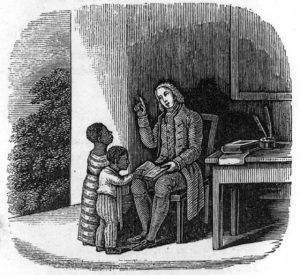
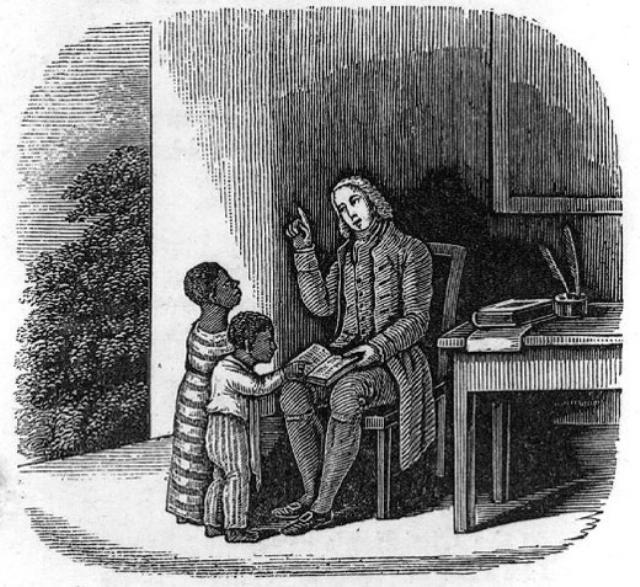
An 1850 image of Anthony Benezet, a colonial-era Quaker and abolitionist, instructing black children. <en.wikipedia.org/wiki/Anthony_Benezet#/media/File:Benezet.jpg> Public domain in the United States.
Through 1775, George Washington owned slaves and thought little of blacks, although he later came to embrace blacks in the Continental Army. During the revolution, Billy Lee, his slave, was his closest companion. After the war, Washington wished to see slavery abolished. This is all undisputed fact, often in Washington’s own words.
Instead, Burns repeats an almost certainly fictitious <www.mountvernon.org/library/digitalhistory/digital-encyclopedia/art icle/darby-vassall> story about a slave, Darby Vasal, who would have been six years old in 1775 during his alleged interaction with Washington. Supposedly, Washington told Vassall to come inside his headquarters to do some chores and, when Vassall asked to be paid, Washington took umbrage. Vassall then claimed later, “Washington was no gentleman”-that is, Burns’s money quote.
The problem, which Burns ignores, is that this story didn’t appear until around 1870, long after both Washington and Vassall were dead. Moreover, when the story first appeared, it was about Darby’s father. For Burns to include this as a documented fact is actual malice.
But that’s just the beginning. Burns repeats a <www.bookwormroom.com/2021/10/11/analyzing-how-leftism-destroys-inte llectual-honesty/> canard central to the 1619 Project: namely, that a central cause of the revolution was <encyclopediavirginia.org/primary-documents/lord-dunmores-proclamati on-1775/> Dunmore’s Proclamation and its threat to slavery. The timeline shows this is a lie.
On November 7, 1775, <encyclopediavirginia.org/entries/dunmore-john-murray-fourth-earl-of -ca-1730-1809/> John Murray, Earl of Dunmore, the <encyclopediavirginia.org/entries/governors-of-virginia/> governor of Virginia, issued <encyclopediavirginia.org/primary-documents/lord-dunmores-proclamati on-1775/> his Proclamation. It declared martial law and emancipated all slaves who belonged to patriots and were willing to fight for the British. Per Burns, “Dunmore’s Proclamation helped drive Southern Slave holders to the side of the revolutionaries.” He then quotes South Carolina politician Edward Rutledge:
Lord Dunmore’s Proclamation tends, in my judgment, more effectually to work an eternal separation between Great Britain and the colonies than any other expedient.
Despite extensive reading on this issue, I have yet to learn of a single southern slave holder-including Edward Rutledge-who supported the revolution because of Dunmore’s Proclamation. Yes, many slave holders were outraged by Dunmore’s Proclamation-George Washington, chief among them-but Burns ignores that the revolutionary die had been cast long before November 7, 1775.
By then, every British North American colony already had or, within two months, would rid itself of Royal government control. The southern slave-holding colonies of Virginia (June 8, 1775), North Carolina (May 28, 1775), and South Carolina (Sept. 15, 1775) embraced the rebellion months before Dunmore’s Proclamation. That rebellion had everything to do with the ancient <grokipedia.com/page/Rights_of_Englishmen> rights of Englishmen and nothing to do with alleged British threats to slavery.
On November 7, 1775, contrary to Burns, the colonists were not debating Dunmore’s Proclamation and slavery. They were arguing whether it was still possible to return to the British fold if Britain reinstated its pre-1760 policies. Moreover, in September 1775, the members of the First Continental Congress had already endorsed the <www.americanrevolution.org/suffolk-resolves/> Suffolk Resolves , an act King George III interpreted as the de facto permanent break with Britain because it called for the colonies to prepare to defend themselves.
This timeline establishes that not a single colony based its decision to sever ties with Britain on Dunmore’s Proclamation. Ken Burns’s cherry-picking quotations don’t change that.
What makes this particularly scurrilous is that, while Burns condemns George Washington and slavery, Burns ignores the reality that an <en.wikipedia.org/wiki/Abolitionism_in_the_United_States> abolitionist movement was being born in colonial America, for the first time in world history. This was a great moment for Western civilization, and Burns ignores it to slander George Washington.
Slavery and humankind developed together, across all races and nations. Slave-based agrarian economies have been the norm throughout <en.wikipedia.org/wiki/Slavery> world history. The word “slave” derives from “Slav,” as in the <en.wikipedia.org/wiki/Slav> Slavic people whom Islamic warlords enslaved in such numbers in the Middle Ages that their very name came to be identified with “slavery.”
Slavery didn’t begin with the African slave trade. Instead, Western slavery ended with the African slave trade, and it did so because John Locke spurred an abolitionist movement that the American colonies then developed.
In John Locke’s 1689 <www.gutenberg.org/files/7370/7370-h/7370-h.htm> Second Treatise of Government, he intertwined English freedoms, government, and the Judeo-Christian religion in one inseparable whole. It was his natural rights theory that all men are born free, with equal rights to life, liberty, and property, and that no man or government could justly violate any of those rights without cause. Chattel slavery was, by all measures, an affront to the natural rights given by God.
Seventy years later, Locke’s arguments had taken root. The abolitionist movement, premised on natural rights, was just beginning to bloom in Britain’s North American colonies. <en.wikipedia.org/wiki/Quakers_in_the_abolition_movement> Quakers and <www.gutenberg.org/ebooks/68144> Methodists were already sharply denouncing slavery as abhorrent to Christianity. Many of the Founding Fathers agreed.
James Otis Jr. vociferously denounced slavery beginning in 1761. In a <oll.libertyfund.org/titles/otis-rights-of-the-british-colonies> widely distributed 1764 pamphlet, he wrote:
The colonists are by the law of nature free born, as indeed all men are, white or black… Does it follow that ’tis right to enslave a man because he is black? … Nothing better can be said in favor of a trade that is the most shocking violation of the law of nature, has a direct tendency to diminish the idea of the inestimable value of liberty, and makes every dealer in it a tyrant.
Samuel Adams, a man indispensable to guiding the revolution in colonial Boston, reacted in horror in 1764 when a friend tried to give him a slave, Surrey, as a wedding present.
[Samuel Adams immediately declared] “A slave cannot live in my house,” … insisting, “If she comes, she must be free.” Emancipated, Surrey remained a fixture at the Adams address for nearly fifty years. In conjunction with a Rhode Island doctor, Adams began to formulate a campaign against slavery. In mid-1766, he joined a committee to introduce a bill prohibiting the importation of enslaved people, one of several efforts over the next decades to eliminate an “odious, abhorrent practice.”
Ben Franklin was impressed after visiting an all-Black school in 1763. He wrote then,
…I have visited the Negro School here in Company with the Revd. Mr. Sturgeon and some others; and had the Children thoroughly examin’d. They appear’d all to have made considerable Progress in Reading for the Time they had respectively been in the School, and most of them answer’d readily and well the Questions of the Catechism; they behav’d very orderly, showd a proper Respect and ready Obedience to the Mistress, and seem’d very attentive to, and a good deal affected by, a serious Exhortation with which Mr. Sturgeon concluded our Visit. I was on the whole much pleas’d, and from what I then saw, have conceiv’d a higher Opinion of the natural Capacities of the black Race, than I had ever before entertained. Their Apprehension seems as quick, their Memory as strong, and their Docility in every Respect equal to that of white Children. You will wonder perhaps that I should ever doubt it, and I will not undertake to justify all my Prejudices, nor to account for them…
Franklin would later become a fierce abolitionist, freeing his slaves and becoming the chief of the <www.benjamin-franklin-history.org/slavery-abolition-society/> Abolitionist Society.
Thomas Jefferson was a 27-year-old lawyer in 1770 when he <tjrs.monticello.org/letter/45> adopted the natural rights theory of Locke and argued for the freedom of a slave, Samuel Howell, because
Under the law of nature, all men are born free, every one comes into the world with a right to his own person and to be his own master.
Six years later, Jefferson would pen a more refined version of that natural rights truism:
We hold these truths to be self-evident, that all men are created equal, that they are endowed by their Creator with certain unalienable Rights, that among these are Life, Liberty and the pursuit of Happiness.
Burns could have rightly said that there is a tremendous amount of cognitive dissonance in Jefferson, a slave owner, condemning slavery on natural law grounds. What he cannot do is claim- <www.npr.org/2025/10/20/nx-s1-5580245/ken-burns-american-revolution- series-includes-voices-the-founders-overlooked> as he does-that the Declaration of Independence was a hypocritical document written solely to benefit white men.
What an odious person Ken Burns is. His history of the American Revolution is <www.nationalreview.com/2025/07/the-1619-project-has-failed-why-do-a cademics-still-take-it-seriously/> as false and libelous as the 1619 Project itself.